
Sabine Parish Projected Release Dates
Louisiana DPS&C uses the exact phrase projected release date (if applicable). The qualifier is essential. A projected date is the department's current calculation for leaving incarceration based on the records and rules then in force. An actual release date records an event that has already occurred. Neither a future date nor a parole hearing date proves that a person left custody.
County status matters. A pretrial detainee at the Sabine Parish Detention Center or courthouse jail has not yet received a sentence that can be reduced to a fixed end date. Bond, an own-recognizance order, dismissal, another court order, or resolution of all holds may permit release. Processing still takes time. A person serving a parish sentence may have a computed term, but the sheriff must identify the authority that performs the calculation and whether DPS&C legal custody is involved.
A sentenced state prisoner can be held in a local-level facility while remaining in DPS&C legal custody. In that case, the state number and locator remain relevant even if the building is in or near Sabine Parish. Physical location and legal custody are separate facts. A federal or immigration case belongs in a separate federal locator and should not be forced into the Louisiana calculation.
Scheduled versus actual: Record the projected date and the date it was checked. After it passes, verify the real release or transfer with the responsible facility and custody system.
Search Sabine Parish Release Dates
The official public starting point for a Louisiana sentence is the DPS&C inmate-information page. It routes online searches to Louisiana LAVNS through VINELink and lists the automated locator at 225-383-4580. The online result can show custody or community-supervision status and is updated daily according to DPS&C. The telephone locator is the documented route for the exact projected-date field.
Call with the DPS&C number when available. Otherwise provide the person's name and date of birth. The automated system can return the current facility assignment, facility address and contact number, assigned Probation and Parole office in applicable cases, and the projected release date if applicable. If it announces no date, DPS&C states that time computation may not be complete and advises trying later. Do not create a date by subtracting an assumed percentage.
- Classify the case as pretrial, parish-sentenced, Louisiana state-sentenced, federal, or immigration custody.
- For state custody, open the official DPS&C page and follow its LAVNS path to match the person and reporting agency.
- Call 225-383-4580 with the DPS&C number, or name plus date of birth, and record the exact projected field.
- For a parish sentence, call the Sabine Parish Detention Center and ask who computes the term and whether DPS&C custody applies.
- Check the Eleventh Judicial District Court record for the sentence, amended commitment, jail credit, and any later order.
- After the projected day, confirm whether the event was community release, transfer, parole, or another custody change.
The full named-person path, including the county record and court route, is available on the Sabine Parish released inmates search page.
Note: A fully discharged person may no longer appear in a locator built for active custody and supervision, so retain the court and agency record.
Sabine Parish Good-Time Boundary
Louisiana's offense-date boundary is decisive. For offenses committed on or after August 1, 2024, R.S. 15:571.3.1 is the central ordinary-good-time statute. A qualifying felony offender in a parish prison or DPS&C custody may earn diminution for good behavior of up to 15 percent of the imposed sentence. Diminution means a lawful reduction in time spent incarcerated. The maximum can yield an approximate 85-percent-served baseline only when the person qualifies and earns all ordinary credit.
That baseline is not a universal Louisiana rule. The same statute excludes a person convicted of a sex offense defined by R.S. 15:541 and a person sentenced under the habitual-offender law in R.S. 15:529.1 from the cited subsection. It allows possible additional diminution under R.S. 15:828 for qualifying people, excludes ordinary good time on certain article 880 time-served credit, permits forfeiture under R.S. 15:571.4, and places the decision to earn or allow credit with the secretary.
The law also states that covered diminution releases serve the remainder as unsupervised parole, subject to R.S. 15:571.5. A split-sentence offender begins probation, with terms running together as the law specifies. Leaving incarceration may therefore start another legal phase rather than end the sentence. Later revocation or conviction can affect that phase.
The successful manifest image comes from the current Louisiana good-time statute.
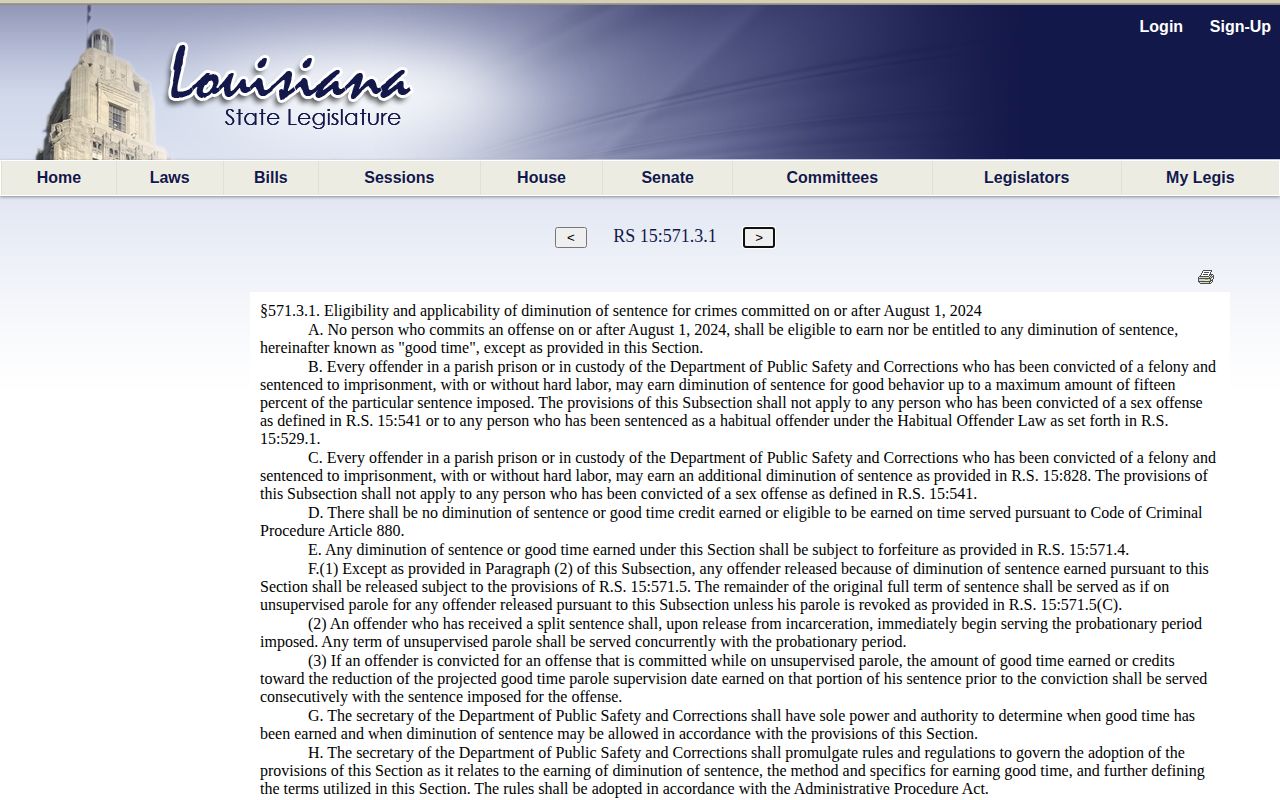
Its exclusions and credit rules show why no simple sentence-times-85-percent calculation can produce an official Sabine Parish release date.
Older Sabine Parish Sentence Rules
Offenses committed before August 1, 2024 may be controlled by the legacy R.S. 15:571.3 framework and the version in effect for the offense date. Rates and categories can differ for violent and nonviolent offenses, repeat cases, parish sentences, and excluded offenses. The date of conviction alone does not replace the offense date. Amendments and special sentencing laws can also affect which rule governs.
A reliable review gathers the offense date, conviction, sentence type, concurrent or consecutive structure, jail credit, and controlling statute. Concurrent sentences run at the same time; consecutive sentences run one after another. Jail credit recognizes qualifying time already spent in custody. A corrected commitment or amended sentence can alter the inputs after the first projected date was computed.
DPS&C or the sheriff makes the official calculation. The Sabine court record explains the judicial sentence and any later order. A public page can help locate those records, but it cannot resolve every fact in a person's sentence. No sourced Sabine-specific weekend-release policy or local good-time formula was found, so none should be assumed.
Sabine Parish Parole Eligibility
Parole eligibility is different from good-time release. Eligibility means the Committee on Parole may consider a person under the controlling law. It does not mean parole will be granted, and it does not turn a hearing date into a release date. Current R.S. 15:574.4 contains a general 25-percent route for certain otherwise eligible nonviolent, non-sex, non-fourth-or-subsequent felony cases. It also describes 65-percent and 75-percent pathways for specified categories and ineligibility for other categories.
Those fractions have offense-date, offense-type, prior-record, and cohort exceptions. Life, juvenile, elderly, and other special sentences can have additional rules. The figure alone cannot predict a hearing or departure date. First identify the exact statutory route. Then use the Committee's docket and result for the decision, followed by DPS&C, LAVNS, the holding facility, and the assigned supervision office for later custody status.
A grant may still be followed by release-plan review, conditions, facility processing, or a detainer. A detainer is a request or notice from another authority that can affect departure or destination. A denial or deferral can change a projected path without changing the underlying sentence end in the same way. Keep parole milestones separate from sentence computation.
Note: The Natchitoches supervision office can verify an assignment after release, but its officers do not choose the Sabine Parish release date.
Why Sabine Release Dates Change
A projected date changes when one of its legal or factual inputs changes. Some changes add credit, while others remove credit or add time. Court paperwork can also reach the department after an earlier estimate. The most useful practice is to preserve the exact date, the system that supplied it, and the day it was checked. That creates a clear basis for asking what changed.
| Factor | Possible effect | Where to verify |
|---|---|---|
| Commitment paperwork | A corrected or delayed order changes the sentence input | Sabine Clerk of Court and DPS&C |
| Jail credit | Qualifying prior custody is added to the computation | Court minutes, commitment, and computing authority |
| Concurrent or consecutive terms | Terms overlap or run one after another | Sentence and DPS&C computation |
| Good time or program credit | Earned credit can move the projection earlier | DPS&C or sheriff computing authority |
| Forfeiture or discipline | Lost credit can move the projection later | Responsible corrections agency |
| Parole decision or revocation | Community release or return-to-custody path changes | Committee record, LAVNS, and DPS&C |
| Detainer or court order | Destination or physical departure can change | Holding facility, court, and requesting agency |
One facility's release can also be another agency's intake. A transfer from the Sabine Parish Detention Center to DPS&C, another parish, federal authority, or ICE is not a community release. Ask the records custodian to label the destination. The date a person leaves one building may be accurate while still failing to answer when all custody ends.
Confirm Sabine Parish Actual Release
Once the projected date arrives, check the system that holds legal custody. For DPS&C, review LAVNS and call the last facility or locator. A released or community-supervision result supports a custody change, though daily updates can lag. For a Sabine parish-only sentence, call the Detention Center at 318-256-0006 and request the booking-specific actual release date, time, reason, and destination. Use the court record to explain the legal authority.
Release notifications can help track a pending change. The Sabine Parish VINE Inmate Check explains how to match one person and register for offered events. LAVNS is not a certified release order or a permanent discharge archive. Eligible victims of a state prisoner seeking projected and actual state-release notices must also review Louisiana Victim Outreach, because DPS&C says its registration is separate from LAVNS.
A projected date should never be silently replaced with an actual date. Keep both labels. If the date passes without a released status, ask about calculation updates, detainers, parole conditions, court changes, and transfers. The answer should identify the agency that now holds the person, not just state that the old facility no longer lists them.
For written proof of a local event, request the booking and release portions from the Sabine Parish Sheriff's Office public-records custodian. Name the person and exact booking, then ask for admission time, actual release time, release reason or authority, and any receiving agency. Article 228 guarantees a public booking-book baseline, but not every requested release field. The court's signed order or minute can explain why release was authorized, while the sheriff record documents when physical custody changed.
For a past state event, use a narrow DPS&C request when the locator no longer carries the needed public disposition field. Broad corrections files can be confidential under R.S. 15:574.12, so identify the person, sentence, date range, and requested release or discharge item. A community-supervision result can confirm that incarceration ended while the legal term continued. A fully discharged person may require the court record and the last responsible facility because active-system visibility can end.